Se afișează postările cu eticheta Articole in limba engleză. Afișați toate postările

Rumi's Death Anniversary 2013

December 17 is the 740th anniversary of the death of the Sufi poet Rumi, whose Persian writings are considered to be a pinnacle of mystical art that transcends religious, cultural and ethnic boundaries.
Also known as Mevlana, he died on December 17, 1273 in Konya, Turkey, where he is entombed below the Mevlana Museum.

Rumi's death anniversary is known in Turkey as Wedding Night, or Seb-i Arus in Turkish, which references the idea that when a Sufi saint dies, he or she is believed to have attained union with beloved God. Therefore, it is an occasion of celebration rather than mourning and Sufis gather together to recite poetry and prayers, and whirl in tribute.

Rumi scholar and author of an upcoming Harper Collins biography on the poet, Brad Gooch, told The Huffington Post, "The main commemoration takes place in Konya every year, with the presentation of the Whirling Dervish ceremony central to the order formed around Rumi after his death, the Mevlevi Order. They are famous for the meditative practice of whirling, their signature ceremony that became elegantly codified during the Ottoman period. "

Fahad Faruqui explained in a HuffPost blog, "It must be obvious, by now, that Rumi's death is no somber event for his devotees. It's actually a celebration." He continued, "Timothy Winter, a lecturer of Islamic Studies at Cambridge University, explains why: 'Rumi's death is the moment of his union with his Lord. In Sufism, God is often symbolized as a feminine beloved, known as Layla.'"

Turkish Prime Minister Recep Tayyip Erdogan has traveled to Konya to pay his respects.

Rumi's poetry continues to inspire long after his death. His epitaph reads, "When we are dead, seek not our tomb in the earth, but find it in the hearts of men."

sursa: huffpost-religion

Who was Bulleh Shah?


Who was Bulleh Shah?Bulleh Shah followed the Sufi patron of Punjabi poetry founded by eminent poets like Shah Hussain, Shah Sharaf and Sultan Bahu. He wrote various forms of Punjabi poetry but the majority of his verses were Kafi’s, a style of Punjabi, Sindhi and Saraiki poetry.

Bulleh Shah is one of the finest spiritual Sufi poets and scholar from the Punjab. His writings are still celebrated in all parts of the world.

Hazrat Baba Bulleh Shah is considered to be one of the most remarkable Muslim Punjabi Sufi poets and scholars.

He was born in 1680 in the village of Uch, Bahawalpur, Punjab, which is currently in Pakistan. His full name was Abdullah Shah.

He was born into a very religious family, his father being a preacher in a mosque. His family had a long association with Sufi’s.
Shah Hussain
Bulle Shah spent most of his life in Kasur, Pakistan right from his education until his death.

After receiving his traditional education in Kasur, Bulleh Shah became a murshid (disciple) of a famous spiritual teacher Qadiri Sufi Shah Inayat Qadiri, who guided him towards spiritual awakening.

From these teachings, Bulleh Shah spent his whole life in search of true self-realisation and spiritual awakening.

A number of Bulleh Shah’s Kafis are sung by present day qawwals. The simplicity in his works and preaching about fundamentals of living makes him all the more famous.

In the present era, many singers have converted his poems and Kafis into melodious songs. Renowned Sufi singers like Abida Parveen, the Waddali Brothers, Nusrat Fateh Ali Khan and Sain Zahoor have sung a number of qawwalis from the compositions of Bulleh Shah.

Various famous modern day music numbers including ‘Bullah ki Jana’ by Rabbi Shergill, ‘Chaiyyaa Chaiyya’ from Dil Se, ‘Ranjha Ranjha’ from Raavan, and so many more, are actually the Kafis of Bulleh Shah.

In his poetry, he talks about his understandings of the world around him, his divine experiences and also raises a voice against orthodox rituals of Islam during that time.

He preached to the masses to leave their egos and not to worry about social conventions if they wish to meet God.

There is a very famous story from the life of Bulleh Shah. This story shows his love and devotion towards his master and his untroubled attitude towards society.

Once, Bulleh Shah saw a young wife desperately waiting for his husband to return home. She dressed up beautifully, braided her hair and wore her best make-up.

Bulleh Shah identified this as pure dedication and affection the wife had for her loved one.

So, Bulleh Shah also dressed up as a female, braided his hair and rushed up to see his master Inayat Shah. This was the level of adoration he had for his master and the love he had for God.

Bulle ShahThe writings of Bulleh Shah portray him as a saviour of the human race as he provides solutions to various social problems in the world around him, as and when he came across them.

The lifetime of Bulleh Shah was concurrent with communal riots between Muslims and Sikhs. During that time, he was a ray of hope and an instrument of peace for the inhabitants of Punjab.Bulleh Shah always preached that if violence is answered with violence it will lead to strife only.

He propagated non-violence and did not support either Muslims or Sikhs in the bloodshed. This made Muslims controversial towards Bulleh Shah.

Bulleh Shah died in 1757. It might be astonishing but it is a bitter truth that at the time of his death, Bulleh Shah was denied burial in community graveyard of Muslims by mullahs because of his unorthodox views.

But today, the tomb of Bulleh Shah in Kasur has become a place of worship and the wealthiest of the city have paid handsome amounts to be buried by the side of such a great soul.

The metamorphic change in he way he is perceived today is owed to the better understanding of Bulleh’s life and preaching by his people and followers.

“Bulleya Ki jaana main Kaun”

Bulleya to me, I am not known
Na main momin vich maseetaan
Na main vich kufar diyan reetaan
Na main paakaan vich paleetaan
Na main moosa na firown

Not a believer inside the mosque, am I
Nor a pagan disciple of false rites
Not the pure amongst the impure
Neither Moses, nor the Pharoh

Na main andar ved kitaabaan
Na vich bhangaan na sharaabaan
Na vich rindaan masat kharaabaan
Na vich jaagan na vich saun

Not in the holy Vedas, am I
Nor in opium, neither in wine
Not in the drunkard’s intoxicated craze
Neither awake, nor in a sleeping daze

Na vich shaadi na ghamnaaki
Na main vich paleeti paaki
Na main aabi na main khaki
Na main aatish na main paun

In happiness nor in sorrow, am I
Neither clean, nor a filthy mire
Not from water, nor from earth
Neither fire, nor from air, is my birth

Na main arabi na lahori
Na main hindi shehar nagauri
Na hindu na turak peshawri
Na main rehnda vich nadaun

Not an Arab, nor Lahori
Neither Hindi, nor Nagauri
Hindu, Turk, nor Peshawari
Nor do I live in Nadaun

Avval aakhir aap nu jaana
Na koi dooja hor pehchaana
Maethon hor na koi siyaana
Bulla! ooh khadda hai kaun

I am the first, I am the last
None other, have I ever known
I am the wisest of them all
Bulleh! do I stand alone?
Bulleya Ki jaana main Kaun
Bulleya! to me, I am not known
 
-Bulleh Shah

sursa: http://www.desiblitz.com/content/who-was-bulleh-shah 

Somalia sees Sufism revival

iol nws pic Somalia Sufi Resurgence


Mogadishu, Somalia - Hundreds of sweating Sufis chant and sway as the lead sheik moves into the middle of a circle of worshippers and bursts into a chant louder than anyone else's 

Sufism, a mystical branch of Islam, is having a major comeback since al-Shabab, an armed militant Islamic group, was pushed out of Somalia's capital in August 2011. The Sunni insurgents had banned Sufis from gathering and prevented them from worshipping. Sufi sheiks, or elders, were attacked, graves of their saints were desecrated and rituals and celebrations became rare or secretly performed. 

Beyond the circle of worshippers are dozens of women, some of them so moved that they are crying. 

Nearby is the grave of a Sufi saint where the worshippers go to pray to show reverence. Free food, including toasted coffee beans fried in oil, is distributed in wooden containers. 

“With Allah's wish, we are here free and worshipping today,” said Sheik Abdullahi Osman, a 72-year-old Sufi cleric, who has beads dangling from his neck. Sufis in Mogadishu spend hours feasting, praying, and invoking Allah's name. Traditionally Sufis used sticks to protect their shrines but now it's common to see a guard with an AK-47 slung over his shoulder in this seaside capital. 

“There's no choice other than defending ourselves and our faith,” said Mohamed Ahmed, an armed Sufi follower guarding the gathering. The arrivals were being checked and other guards stood outside a gate. 

Ruqiya Hussein, a veiled woman, traveled from an al-Shabab-held town 90 kilometers (55 miles) away to get to a place of worship. 

“I am thrilled to see my sheiks come back to lead us again,” she said, squeezing her henna-tattooed fingers before she joined a group of women swaying and chanting rhymes. 

Sufis were known for spreading Islam across Somalia through peaceful teaching and practicing tolerance toward other faiths. Some Sufis hope that their style finds fertile ground in a nation recovering from the wounds of extremism and war. 

“Unlike others we don't kill or harass people. Instead, we provide examples of how to live.” said, Sheik Abdirizaq Aden, the regional leader of the faith. 

Al-Shabab, a group of al-Qaida-linked militants that seeks to instill an ultra-conservative brand of Islam across Somalia, controlled Mogadishu from roughly 2007 to 2011. The group still dominates most of south-central Somalia but has seen its territory reduced after military pushes by African Union and Somali forces. 

The Sufis in the capital now feel free to practice their faith. In central Somalia, after the graves of sheiks were desecrated and killings occurred, Sufis used weapons to kick militants out of some key towns. The conflict in that part of the Horn of Africa nation persists. 

Somalia fell into chaos in 1991 when warlords overthrew longtime dictator Siad Barre and turned on each other. Two decades of violence followed, but the capital and some other towns have seen strong security gains during the last 18 months that have allowed businesses and even sports leagues to thrive. - Sapa-AP 

By ABDI GULED

Photo: In this photo taken Friday, April 19, 2013, Sufis eat traditional toasted and fried coffee beans during a ritual service at the Sufi's main center in Mogadishu, Somalia. (AP Photo/Farah Abdi Warsameh)

Holy imprints from another time


Over 50 highly rare and old manuscripts are put on display at a special exhibition inaugurated at the National Museum of Pakistan.

Aadab Ul Murideen translation by Shaikh Abul Najeeb Abdul Qhair bin Abdullha Serwadi - Naksh - 711 A.H to 1307 A.D.  


The exhibition of manuscripts titled “Tasawwuf and Interfaith” organised by the Sindh culture department and the International Peace Committee for Interfaith Harmony will continue till Feb 26.

One of the 50 manuscripts on display is over 1,000 years old, said to be the oldest one that the museum has, and another one is around 800 years old while the rest are three to four hundred years old.

The manuscripts include various holy books of different religions, including Islam, Hinduism, Christianity and Sikhism.The manuscripts of the Quran, the Bhagavad Gita, the Bible and the Guru Granth Sahib are on display among other exhibits.

The manuscripts of Shah Jo Risalo and texts on Tasawwuf are on display as well.

One manuscript was of the Bhagavad Gita with translations in Sanskrit, Persian and Urdu.

Another rare book on display was a translation of the Bible and commentary on it by Sir Syed Ahmed Khan.

Earlier, a seminar was held where speakers pointed out that the Indian subcontinent in general and Sindh in particular was the land of love and peace where people of different religions had been living in harmony for the past many centuries.

However, over the past few decades, extremism had made inroads into society and intolerance had spread, they added.

They stressed the need for organising such seminars and workshops so that the message of love, peaceful coexistence and harmony could be spread.

They said that efforts should be made to make the country like one the Quaid-i-Azam had envisioned.

They said that all religions gave the message of love and peace. But it were only a few misguided souls who misused the name of religion to get their short-term gains and if saner elements of society joined hands and made concerted efforts, society could once again become like it had been earlier where everybody lived in peace and harmony.

The speakers included Bishop Sadiq Danial, former MPA Michael Javed, Mohammad Ali Manjhi, Aijaz Chajhro, former city government councillor Mangla Sharma, Sardar Ramesh Singh, Mohammad Shah Bokhari, Dr Idrees Ahmed, Nasir Jehangir and others.

Sindh Culture Minister Sassui Palijo had been invited as the chief guest at the seminar and to inaugurate the exhibition, but she could not make it owing to other pressing engagements outside the city, said museum chief Mr Bokhari.

The remaining 20 photos at: website dawn.com
 
Text by Salman Peerzada/ Photos by Shameen Khan/Dawn.com and Alisia Pek/Dawn.com
Posted on: February 22, 2013, sursa

The legacy of Sufi poet Omar Ibn El-Farid*

*Ibn El-Farid is one of the greatest Egyptian mystic poets

Ibn El-Farid’s mosque Abdel-Rahman Sherief The city of the dead, or Qarafa, located in the heart of Cairo, is, unlike most Cairo’s neighbourhoods, clean and tranquil. It is the burial place of many historic Egyptian figures, including the great poet Omar Ibn El-Farid.

Ibn El-Farid, son of El-Farid in Arabic, or Sidi Omar as known locally, is one of the greatest Egyptian mystic poets. To this day his poems still read beautifully, including his masterpiece The Sufi Way, which is also the longest mystic poem ever written.

Born in March 1182, Ibn El-Farid was brought up to follow in his father’s footsteps and become a legal advocate. El-Farid in Arabic means he who advocates women’s rights in Shari’a or Islamic legislation.

However, Ibn El-Farid abandoned his studies and instead chose a solitary religious life. He frequently retreated to the foot of Moqattam hill for periods of spiritual reflection, and a mosque and shrine were built there to honour the significant reverence Egyptians in general and Sufis in particular have for him.

Ibn El-Farid left Egypt for Mecca where he studied Islam and Sufism with the prominent Iraqi mystic sheikh Ibn-Al Suhrawardi for 15 years and it was there that he composed most of his poetry. In Mecca he continued his religious solitary life and meditated on the meaning of life, the relationship between man and God and the nature of Sufism. He communicated his thoughts and reasoning through poetry.

Many historians mention in chronicles and biographies that Ibn El-Farid was able to compose more than 45 verses at once and that he was able to enter long states of ecstasy that could continue for 10 or more days. During these states he would not eat, drink or sleep, insisting that he was being nourished spiritually.

In Sufi history many stories about Ibn El-Farid and his miracles, known as karamat, are preserved and still find an audience eager to believe in his spirituality. One of the legends says that Ibn El-Farid was protected during his spiritual retreats by two lions send to him by God, while other tales mention special mystical and metaphysical abilities.

The mosque in Al-Moqattam was built in the 18th century by the Ottoman prince Ali Kared, who built another tomb for himself beside the mosque. In 1928, Princess Jamila Fahmy, King Fouad’s aunt, dreamed of Ibn El-Farid, quietly asking her to care for his mosque and shrine. The princess responded to his call and restored and renovated the mosque. He also built a huge, adorned dome beside it which still carries her name, Jamila’s Dome.

The mosque itself cannot be compared to the magnificent designs of Al-Hussein or Al-Azhar, but its location at the foot of Al-Moqattam and its simple structure lend it an atmosphere of peace and tranquillity.

The guard of the shrine said many foreigners also come to visit Ibn El-Farid shrine, especially during the summer and when his birthday is celebrated in March. Another Sufi singer, Yassin Al-Tohamy, is known for holding a celebration concert at the shrine every year on Ibn El-Farid’s birthday, when he recites Sidi Omar’s poems.

On these occasions Al-Tohamy’s mellow voice echoes over the city of the dead as he recites the timeless poems of Ibn El-Farid, and the sense of deep spirituality is shared among all those who have come to remember one of the greatest Sufi poets.

autor:   
sursa: dailynewsegypt.com

resurse suplimentare: http://www.poetry-chaikhana.com/Poets/I/IbnalFaridUm/


Whispering, then listening close (from The Poem of the Sufi Way)

by Umar Ibn al-Farid  
 
Whispering, then listening close
     from the vision of one
          casting away his all, instantly,
               out of an omnipotent hand.

Thus I read the knowledge of the scholars
     in a single word,
          and I reveal all the worlds to me
               with a simple glance.

I hear the many voices
     of those who pray in every tongue
          in a space of time
               shorter than a flash.

And I bring before me
     what before had been
          too far away to bear,
               in a blink of my eye.

I inhale the bouquet of gardens
     and the sweet scents clinging to the skirts
          of the four winds,
               in a simple breath.

I survey the far horizons round me
     in a momentary thought,
          and cross the seven heavens
               with a single step.


English version by
Th. Emil Homerin
Original Language
Arabic

End of an era: Renowned Sufi singer Iqbal Bahu passes away

LAHORE: Renowned singer Iqbal Bahu passed away in Lahore on Saturday after complaining of chest pains. He was 65. He was known for his singing of Arfana kalam (devotional songs).
 
Born in Gurdaspur, Indian Punjab‚ Bahu migrated to Pakistan after partition and settled in Lahore. After completing his education, he worked in National Bank.  Bahu had mastered the Sufi tradition of well-known Sufi saint Sultan Bahu and had great command over folk songs as well mystical and devotional poetry.

But the kalam of Sufi poet Baba Bulley Shah was his claim to fame and his name was changed from Muhammad Iqbal to Iqbal Bahu. His most popular kalams are ‘Alaf Allah Chumby Dee Booti’ and ‘Maain Ne Main Kino Aakhan’. To perfect his singing of the Sufi kalam, he is believed to have sought the help of language experts in order to pronounce the words accurately.

Bahu performed for the radio, on stage, and the television in Pakistan as well as in European countries. On March 14, this year, he travelled to India to perform his Sufiana and Arfana kalam in Lucknow and returned to Lahore on March 20. Since his return, Bahu had been suffering from a cough.

On Friday, he was taken to the Punjab Institute of Cardiology where a report of his angiography was positive. He was later shifted to the Services Hospital where he expired during the course of treatment.

Bahu leaves behind his wife, three daughters and two sons.  The soyem will be held at his residence in Allama Iqbal Town, Lahore after Zuhr prayers.

Published in The Express Tribune, March 25th, 2012.

In Retrospect - The Fez Festival of Sufi Culture, 2011

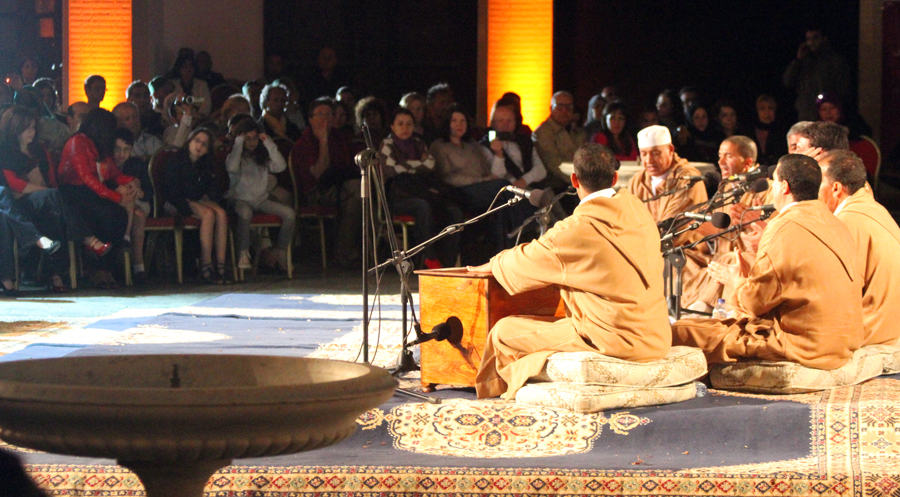
The fifth Festival de Fès de la Culture Soufie - The Fez Festival of Sufi Culture - was an overwhelming success. From the opening night concert with Moroccan singer, Karima Skali, through the nights of Samaa to the final concert at the Hotel Jnan Palace, the audiences were large and appreciative. Here is our wrap-up of the Festival.
 

The focus of the festival was on the female aspects of Sufism and this theme was explored in the 10am and 4pm conferences and round table discussions. The well attended conferences ranged across topics from the female saints of Morocco to the writings of Isabelle Eberhardt.

The only disappointment was the cancellation (due to illness) of Sir Nicholas Pearson and the fact that English is still not employed (with one exception) in the discussions, introductions or the programme. While being aware of budgetary restraints, the large number of English speaking visitors makes English important. The other improvement needed is a more descriptive programme with notes on the various brotherhoods, the name of their leader and so on.

The venue, the Batha Museum courtyard was, once again, perfect, with the sound and lighting of the highest standard. Even when rain threatened, the erection of small tents enhanced the intimate feeling.

The feminine was not as present in the evening events which were more about immersion in and reflection on the spiritual aspects of dhikr and samaa. Too often in presentations such as these, there is a sameness that is discernible, even by the uninitiated. This was not the case at this festival, with every evening having a distinctive tone that made for an exhilerating week of discovery.

The highlights


While many of the locals in the audience had strong affiliations with particular Sufi brotherhoods, without doubt the highlights for almost all visitors were the energy and spectacle of the Tariqa Khalwatiyya. Yet, beyond the spectacle, the power of the devotion at the core of the Turkish dervishes was apparent to all. It
was both an exciting and deeply moving event.


Experiencing the power of the Boutchichiyya or the intensity of the other brotherhoods, it would have been difficult to pick a highlight - that is, until the Tariqa Siqilliya entered the courtyard at the Batha Museum.


For those who had not seen this brotherhood before, the glorious polyphonic singing was such a surprise that there was an audible gasp from many in the audience. Not only was the polyphony entrancing, but the voices of those who sang solo lines amidst the chanting, were superb. It was THE stand out event of the festival.
See reviews of the Siqilliya HERE and HERE
 
A small gripe: please wait until after the last concert before dismantling the Coke fridge and stacking up chairs. This was distracting.
 
A VISITOR'S PERSPECTIVE 
 
Fitz Morrissey read about the Sufi festival on The View from Fez and decided to visit Fez with a friend. They are both students of Arabic and Islamic studies at Oxford University. Fitz kindly offered to write about his experiences.

Fitz Morrissey and Chris Lyle
A trip to the Fez Festival of Sufi Culture, 2011

When I first decided to visit the Festival of Sufi Culture in Fez, I'd imagined a somewhat low-key affair: a few academic lectures attended by a select group of Sufism enthusiasts, and if we were lucky a recital or two from some real-life Sufis. What we got instead was an extravaganza, a festival in the true sense of the term celebrating all that is good about religion. Here, at the Batha Museum in Fez, was the place to be. Where I had imagined an esoteric gathering came an eclectic group from near and far, some young, some well traversed on the Sufi path. Many were imbued with a sense of deep piety that added to, rather than hindered, their life-affirming outlook. When one told me, "This is the true Islam, not the one you see on the TV," I understood what she meant.

Faouzi Skali's festival at all times reflected Sufism's focus on the harmony between the outward and the inner, on the underlying unity of superficial difference. By day we had the all-enveloping cosmology of Ibn al-'Arabi, biographies of those female saints whom history has suppressed, poetry from Rabi'a, Rumi and Goethe. All, though coming from different backgrounds and writing in different ages, seemed united by a shared appreciation of the power of love in and of God. With every talk my knowledge was broadened and my sense of wonder heightened. Importantly, this was not just staid academia, but a project that needs to be actualised. Sufism is a living reality, and thus a potential vehicle for both the remembrance of God and the betterment of oneself as a human being. It is through festivals such as this that this message of love and tolerance, and especially this year the celebration of women's role in the tradition, can be shared with those whom Sufism was previously unable to reach.

And then there were the concerts. I'd enjoyed al-Kawthar and the Ensemble Ibn 'Arabi, two professional Sufi groups playing music from al-Andalous, enough on the first two days to go home contented there and then. Little did I know that round the corner were the sama' recitals of the Sufi brotherhoods, each unique in its own way, yet all united by a common purpose of the annihilation of the ego. These events were like no other concert I'd ever been to. Here one felt not a member of the audience, but rather part of a congregation, a participant in an ancient ceremony. On Monday night, when the Turkish Khalwatiyya brotherhood whirled, swayed and rocked to the rhythm of their trance-inducing chanting, at times menacing and at others a picture of tranquility, a part of me wished that I too was a Sufi. What's more, every performance, from the Boutchichiya to the Siqilliyya, featured singing and playing of the highest quality. Sama' is ritual, but it's also great music. Every night we saw a different take on the dhikr (remembrance of God) ritual, once more highlighting the rich diversity of Sufi culture. How can we generalize about Islam when so varied are the modes of expression of a Muslim's commitment to God?


The Festival was a real joy to attend, surpassing my expectations, confirming and confounding in equal measure. I saw an outwardly foreign culture to be in fact a resource of common humanity. I met Moroccans, French, Turks, Nigerians and English, all taking something different from each event, but all united by their wish to partake in this spectacular celebration. Faouzi Skali should be lauded for the conception of this project, which everyone I spoke to said gets better year upon year. I certainly hope so, as I'm sure I'll be drawn back to Fez, the perfect setting for this festival of mystical and traditional spirituality, at some time in the future.  -  Fitz Morrissey

ON THE LIGHT SIDE

"Aisha" - The Sufi cat was at every performance.
 
The devotees added colour and movement
 
Even during chanting one brotherhood member had time to find the number and then make the call !
 

OUR CONGRATULATIONS...


To Faouzi Skali on presenting a world class event that leads to greater appreciation of many aspects of Sufi Culture. To his entire team from security through to administration, lighting and sound who made the event a pleasure to attend... and to the visitors from around the world who made the effort to come and join the locals in Fez for a wonderful festival.


To see all our stories on the Sufi Festival CLICK HERE
Photographs: Sandy McCutcheon. Additional photographs: Gerard Chemit.

sursa: http://www.globalpost.com/webblog/morocco/retrospect-the-fez-festival-sufi-culture-2011

Conference calls for 'purification' of Sufi orders

A conference held by leading representatives of Sufi religious denominations on Saturday [13/02/2010] called for the registration of all officially acknowledged Sufi orders and for forbidding what it called "intruders" from organizing events not in accordance with established Sufi doctrines.

Conference participants criticized some of the dances performed during religious events organized by what they called "false" Sufi sects. They also condemned the practice of erecting tents that are shared between men and women at these events.

"Sufism must be purified from such intrusive practices," Sheikh El-Husseini, leader of the Husseini Sufi order, said.

According to another Sufi leader, Sheikh Alaa Eddin Abul Azayem, "No genuine Sufi order would ever allow men and women to share the same tent at a religious event."

Some conference attendees also blasted a recent documentary film about Sufism entitled "Al-Mawled," produced by Al-Jazeera News Cairo Bureau Chief Hussein Abdel Ghani, accusing the latter of promoting "false information."


Sun, 14/02/2010. Translated from the Arabic Edition.
sursa: http://www.almasryalyoum.com/en/node/16439

Initiation au Soufisme par Éric Geoffroy, nominé aux «Book of the Year» par Foreword Magazine

Initiation au Soufisme nominé aux « Book of the Year » par Foreword Magazine

La traduction anglaise d’"Initiation au Soufisme" a été nominée aux Etats-Unis en tant que « Book of the Year » par Foreword Magazine dans la catégorie Religion. Représentant plus de 350 éditeurs, les nominés ont été sélectionnés parmi 1400 titres en 56 catégories. Le prix sera annoncé en juin 2011, lors de la session annuelle de la ALA (American Library Association) à la Nouvelle Orléans.


Introduction to Sufism: The Inner Path of Islam

English translation of Initiation au Soufisme, published by World Wisdom, Bloomington (IN), 2010, 240 p.

Publisher’s presentation :
This, the first book in English from an authority on Sufism, Éric Geoffroy, introduces Sufism from many angles and from its origins up to the present day. Geoffroy sees Sufism as a unique lens through which we can view the spirituality that lies behind the forms of Islam. Having its source in the Koran and in the prophetic Tradition, Sufism’s goal is to deliver practitioners from the negative human passions, and the illusions, that beset them. This book covers the history of Sufism from its earliest days up until our own times, touching on the many significant people, practices, ideas, and controversies that have shaped it. It also highlights Sufism’s universal aspects, which are a powerful antidote to various fundamentalisms. Geoffroy’s special treatment of the subject balances the voices of long ago (e.g. Ibn ‘Arabī, Rūmī, Hallāj, and Ghazzālī) with many contemporary voices to cover a remarkable scope of topics essential to a full understanding of authentic Sufism. The work concludes with the prospects for contemporary Sufism and with its increasing role in the West.

Translator’s Foreword excerpt :
Both seekers and scholars will find that this book, besides being wide-ranging and well researched, has a rare attribute: by articulating so well the disputes between the scholars of the letter of the divine Law and Sufis, and then between different currents within Sufism itself, Dr. Geoffroy has given us a book that lends itself like few others to discussion and debate. We can easily imagine lively conversations, whether in college classrooms or in readers’ living rooms, framed by the contents of this volume.
—Roger Gaetani, co-editor of Sufism: Love and Wisdom.

surse: 
http://www.institut-du-soufisme-de-france.fr/Initiation-au-Soufisme-nomine-aux-Book-of-the-Year-par-Foreword-Magazine_a1331.html
http://www.eric-geoffroy.net/Introduction-to-Sufism-The-Inner

Mystic women

One of my favourite chapters in the Quran is Surah Al Azhab which clarifies that our ranking with God is based on piety, not gender. Allah addresses men and women in the same breath: "O believing men and women, obedient, truthful, patient, humble, charitable and fasting men and women...."

According to Islam, the creation of Eve was not an afterthought; it was part of the primordial design of Creation. In the Quran, God says: "And everything we have created in pairs" (51:49). The Quran does not blame Eve for tempting Adam to eat the forbidden fruit; it holds Satan responsible for leading them both into sin.

Leadership roles


In the early days of Islam, Muslim women enjoyed leadership and community-building roles. Though cultural influences later corrupted the understanding of their rights, women continued to excel in religious science and there were several scholars of note. A quarter of the Hadith or the Prophet's sayings that form the corpus of Muslim faith, were gleaned from women. Interestingly, while Islamic history acknowledges instances of men fabricating Hadith, no woman was ever accused of this. Their intellectual integrity in conveying religious truth has never been in doubt. Women jurists passed fatwas or religious injunctions and these were respected even if they were in contravention of male opinion.

As spiritual masters and exemplars of Islamic piety, Muslim women often made their mark. There were any number of women scholars, poets, mystics, ascetics and founders of Sufi sects. They were leaders in their own right, often surpassing men in their understanding of the Quran and Islamic doctrine. Sulami, a 10th century Iranian scholar, compiled a rare study of 80 women Sufis.

Divine love 

 
Many theologians refer to the Prophet's daughter Fatima, as the head of the Sufi order. A striking aspect of women Sufis is their intimate relationship with God and complete surrender to Him. Sufis credit Rabia Basri, eighth century mystic, with initiating the philosophy of Divine Love. She said that God be loved for His sake alone and not for reward of heaven or fear of hell.

Other women mystics include Umm Haram whose tomb is in Cyprus, Rabia bint Ismail and Muadha al Adaiyya of Syria, Nafisa of Mecca, Zainab and Ishi Nili of Persia and Fatima of Nishapur who lived in Mecca.

Ibn al Arabi, one of the greatest Sufi masters of all time, wrote that two women mystics, Shams of Marchena and Fatima of Cordova, had a great influence on him. About Fatima, he wrote: "I was her disciple...for several years.... She once told me 'I take joy in Him Who has turned to me and made me one of His Friends, using me for His own purposes'."

Bayazid Bistami, ninth century mystic, described Fatima of Nishapur as his teacher and would refer to her as an evolved soul. Dhun Nun, the Egyptian Sufi master, also acknowledged her scholarship and piety. When someone asked Dhun Nun who was the highest among Sufis, he replied: "A lady in Mecca, called Fatima Nishapuri, whose discourses bring out the essence of the Quran."

Fatima is said to have counselled him: "In all your actions, watch that you act with sincerity and in opposition to your lower self. Whoever doesn't have God in his consciousness is erring and in delusion, whatever language he speaks, whatever company he keeps. Whoever holds God's company, never speaks except with sincerity and assiduously adheres to a humble reserve and earnest devotion in his conduct."

Scholarship and piety 

 
Women mystics either rejoiced or wept in devotion. Sha'wana, a Persian seeker would weep. She would say: "The eyes, prevented from beholding the Beloved, and yet desirous of looking at Him, cannot be fit for that vision without weeping." People would flock to hear her songs and discourses.

Many would seek out Sayyida Nafisa, a ninth century Egyptian known for her scholarship and piety, for her blessings. Several religious scholars, including Imam Shafai, founder of one of the four schools of Islamic jurisprudence, attended Nafisa's discourses and discussed matters of religious law with her. Before he died in 820 AD, he expressed his wish that Nafisa conduct his funeral prayer. But constant fasting had rendered Nafisa too weak to travel so Imam Shafai's body was taken to her in deference to his wish.

Despite the outward male and female form, there is no place for 'i' within Sufism; all that exists is 'Thou', the One Divine Reality. 


sursa: http://timesofindia.indiatimes.com/life-style/spirituality/mysticism/Mystic-women/articleshow/7700333.cms

Learning from saints: Khwaja Moinuddin Chisti

Khwaja Moinuddin Chisti spread the message of universal love and peace, writes APJ Abdul Kalam

In September 2001, I visited the Dargah Sharif of Sufi saint Khwaja Moinuddin Chisti, better known as Gharib Nawaz, at Ajmer. Here, in AD 1256, at the age of 114, the saint entered his cell to pray in seclusion for six days, at the end of which he passed away. As I went round the Dargah, I was struck by the beauty of all that the shrine symbolised. Eight hundred years ago, a saint travelled from Arabia, passing through many lands before reaching Ajmer. Here he brought together different communities who lived peacefully around his shrine.

Gharib Nawaz

The teachings and message of Khwaja Gharib Nawaz has been of an exceptional character. His simple teachings penetrated even a stony heart; his affectionate look could silence the fiercest enemy; he brought the message of universal love and peace. Chisti Sufis who succeeded him continued the tradition set by him. There were truly the pioneers in national integration.

The teachings of Khwaja Sahib have been recorded in several books. For him, one who possesses the magnanimity of the river, the kindness of the sun and humility of the earth is closet to God. Khwaja Sahib said that the noblest character is possessed by one who is graceful in poverty, content in hunger, cheerful in grief and friendly in hostility. According to this great saint, the surest way to avoid the punishment of hell is to feed the hungry, to redress the aggrieved and to help the distressed. Khwaja Sahib gave a role model of Aarif, one who considers death as his friend, comfort as his enemy and always remembers God. An Aarif fears, respects and possesses shyness.
 
Be at peace

Why can't we conduct ourselves as Aarifs? I wondered. Before any action, ask yourself: 'Is what I am about to say or do going to bring me peace?'...if the answer is yes, proceed wholeheartedly with it and you will be allowing yourself the wisdom of your highest self. If the answer is no, be cautious of your ego that is at work.

The ego promotes turmoil because it separates you from everyone, including God. At Khwaja Sahib's shrine I could listen to the voice that only wants you to be at peace with yourself.

Ajmer is located in the picturesque Aravali range. Besides the Dargah Sharif, Ajmer has the holy lake of Pushkar. These two holy places symbolise, as it were, the abiding amity between the two major religions of India. Ajmer presents a model of a peaceful society. I offered namaz as a thanksgiving for this amity. The scene reminded me of the similar location of two other religious centres, Nagore Dargah and Velankani Church.

http://www.flickr.com/photos/campwala/503401364/

Sursa: http://articles.timesofindia.indiatimes.com/2011-02-28/holistic-living/28641538_1_khwaja-gharib-nawaz-ajmer-khwaja-moinuddin-chisti

Sufism in Afghanistan explored

Shrine of Rahman Baba in Peshawar, the most famous Pashto Sufi poet
Shrine of Rahman Baba in Peshawar, 
the most famous Pashto Sufi poet

As BBC Pashto and Persian launch a four-part series on the future of Sufism in Afghanistan, Kabul Bureau Editor Dawood Azami explains how his team went about reporting on a highly secretive group of mystics.

Travelling is not easy or risk-free in Afghanistan.

Although we collected most of our material – including interviews with experts, historians and a number of Sufis – in the capital Kabul, a lot of material also came from the provinces.

Colleagues based in different provinces were asked to attend Sufi ceremonies, talk to Sufi masters there and send the material back to Kabul.
Video clips came back from Kandahar, Mazar and Herat, with additional photos from Sufi sites in Kabul and Peshawar.
Some members of certain Sufi brotherhoods became anxious and even nervous when they saw a radio mic, and many of them didn’t want to be filmed or photographed during their ceremonies and colourful rituals.
                   Kabul Bureau Editor Dawood Azami 

The result is four 15-minute documentaries, each focused on one particular topic – Sufism’s origin and history; orders and brotherhoods; Wahhabi-Sufi relations; and Sufism in present-day Afghanistan.

Secretive group

Sufism – or Tasawwuf – is the mystical dimension of Islam. As one of the biggest centres of Sufism in the Muslim world, Afghanistan is commonly called ‘the home of Sufi saints’.

The word derives from ‘suf’, the Arabic for wool, referring to the woollen robes worn by early Muslim ascetics.

There is a general belief that Sufis possess ‘karamat’ – a miraculous psychic spiritual power that enables masters to perform acts of generosity and bestow blessings. People visit their tombs when they die and hundreds of ziyarats (shrines) have been popular pilgrimage sites for centuries.

Sufis are considered a secretive group of people, but they exist in all parts of the Muslim world and now even in many Western countries.

Some members of certain Sufi brotherhoods became anxious and even nervous when they saw a radio mic, and many of them didn’t want to be filmed or photographed during their ceremonies and colourful rituals.

Shrine of Khwaja Abdullah Ansari in Herat, one of the most famous Sufi masters, who wrote several books in Persian
Shrine of Khwaja Abdullah Ansari in Herat, 
one of the most famous Sufi masters, 
who wrote several books in Persian

While many Afghans believe that Sufis possess hidden knowledge and that they can read other people’s minds, Sufis themselves generally avoid talking about such things and see it as a matter between the individual and his creator, Allah.

Showing respect

Although Sufis are generally very welcoming to outsiders and non-Muslims, there seems to be a suspicion and an issue of trust when it comes to non-members.

But usually after a brief conversation, they are convinced that we journalists don’t have any bad intentions.

I remember facing similar problems on a bigger scale when I was doing my research on the survival of Sufism in Turkey back in 2003.

Even more difficult was recording interviews and taping rituals during special ceremonies – Sufis maintain that human beings are creatures of Allah and they should be shown respect.

Lessons learned

In making these documentaries, I have learned two things in particular.


Firstly, that many people – both inside and outside of Afghanistan – have little or no knowledge that many Afghan cities have been among the most important centres of Sufism throughout its history.

Secondly, I have learned that there is also a growing belief in many quarters that Sufis – who could potentially persuade a large number of Taliban fighters to lay down their arms – need to be given a more prominent role in the country’s ongoing peace process.

BBC Pashto and Dari/Persian services will start broadcasting a four-part series of radio documentaries about Sufism in Afghanistan each week from Tuesday 22 February in its evening transmissions (1400 GMT (Dari) and 1500 GMT (Pashto)). The series will also be available on click www.bbcpersian.com/afghanistan and click www.bbcpashto.com. Presenters are Safiullah Aminzadah (Dari) and Freba Zaher (Pashto)

Sursa: http://www.bbc.co.uk/worldservice/worldagenda/2011/02/110221_worldagenda_sufism_afghanistan.shtml